Teeth in a day: Full-arch implant surgery is done in one day under sedation, and you go home with temporary teeth.
Full-arch = All-on-4: Four implants is the minimum. Premier usually plans five or six for stronger support, and doesn’t charge by the number of implants.
About six months to final teeth: Initial healing takes about two weeks, a normal diet returns after two to three months, and final teeth follow after a try-in.
Not everyone is a candidate: Thin bone, gum disease, smoking, diabetes and bone-altering medications all need careful evaluation with a CT scan.
Maintenance makes them last: Plan on a yearly visit where the teeth are removed, cleaned and checked, “like the service on your car.”
If you’re missing most of your teeth, living with a loose denture, or facing a mouth full of failing crowns, full-arch dental implants can give you a complete, fixed set of teeth that look and feel like your own. The surgery itself takes just one day. But as Raleigh prosthodontist Dr. Hugh Murphy explains, what happens before and after that day matters just as much.
Here’s what to know about full-arch implants in Raleigh: who they’re right for, what surgery day looks like, how recovery works, and how to make your new teeth last.
What are full-arch dental implants?
Full-arch implants replace an entire upper or lower set of teeth with a single, fixed prosthesis, a custom bridge of teeth and gums attached to dental implants in your jaw. Unlike a denture, it doesn’t come out at night, slip when you eat, or need adhesive. Full-arch implants are one of the most common forms of full-mouth reconstruction, rebuilding an entire set of teeth for both function and appearance.
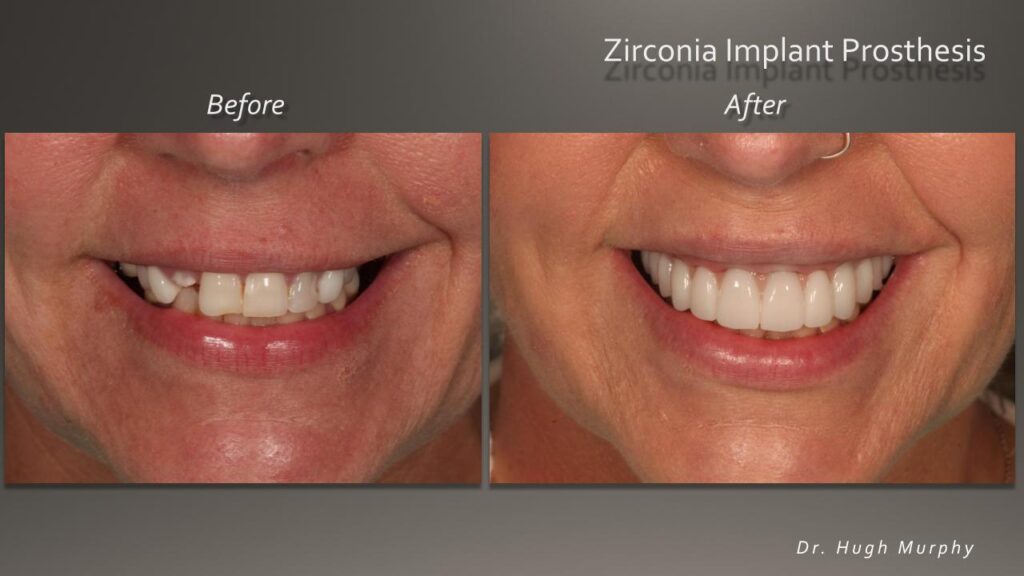
A zirconia full-arch prosthesis, custom-designed to look like natural teeth and gums.
Is full-arch the same as All-on-4? Yes. “All-on-4” is just a popular term, and the “4” refers to the minimum number of implants that can support a full arch. As Dr. Murphy puts it: “It’s All-on-4, none on three.”
In practice, Premier Prosthodontics usually plans five or six implants per arch, or however many are needed for strong, long-term support. And you’re not charged by the number of implants. The plan is based on what your mouth needs, not on keeping the implant count low.
Who is a good candidate for full-arch implants?
Missing upper teeth replaced with a fixed full-arch implant bridge.
Many people can have full-arch implants, and age on its own isn’t a barrier. But not everyone is a good fit, and Dr. Murphy stresses that recognizing who is and isn’t matters most.
Things that affect candidacy:
Bone: Very thin bone around the teeth can make full-arch treatment riskier.
Gum disease: Active periodontal disease raises the risk of complications and implant failure, so it needs to be addressed first.
Smoking: Smoking cuts off blood supply to healing tissue and can lead to poor healing and bone loss around implants. Vaping may also play a role.
Diabetes: Diabetes calls for special planning around healing.
Bone-altering medications: Drugs such as Fosamax and other bisphosphonates, often taken for osteoporosis, need to be reviewed before surgery.
The only way to know for sure is a consultation with a CT scan, which Premier reviews with you the same day.
Planning and surgery day: teeth in a day
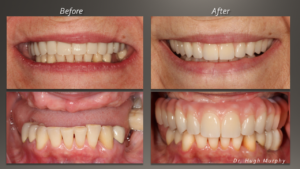
Failing upper teeth and old crowns replaced with a fixed full-arch implant bridge.
The surgery happens in a single day, but a lot of planning goes into it first.
Photos and a CT scan show your bone, your bite and your smile in detail.
Smile design: your new teeth are designed in advance, so everything is ready for surgery day.
Surgery under sedation: every full-arch patient at Premier is sedated. While you’re asleep, the implants are placed, the bone is shaped, and your new teeth are fitted to the implants.
You wake up with teeth. Then you go home and rest.
For full-arch cases, periodontist Dr. Thiago Morelli places the implants, and prosthodontist Dr. Hugh Murphy designs and fits the teeth. Both work under one roof, so planning, surgery and the teeth are coordinated from the start.
Careful planning also keeps surgery day efficient. “No surgery should ever take 8 to 10 hours,” Dr. Murphy says.
Recovery and your final teeth
From surgery to final teeth takes about six months. Here’s what that looks like:
When
What happens
Surgery day
Implants placed; temporary teeth attached before you go home
First 2 weeks
Initial healing; most people feel much better by the end. First follow-up visit
1 month
Follow-up visit
2–3 months
Gradual return to a normal diet
3 months
Scans taken to design your final teeth
Next ~2 months
Two more visits: try in the design, then receive your final teeth
Why temporaries first? You leave surgery day in temporary teeth, a fixed denture-style bridge attached to the implants. Once you’ve healed, Dr. Murphy designs your final teeth and has you try in the design before they’re made, so you see and approve your new smile in advance.
The in-house lab difference. Many offices hand the design of your teeth to an outside lab. As Dr. Murphy puts it, then “you’re at the mercy of the lab.” At Premier, he controls the design himself in the practice’s own lab, so your teeth are made to look like you, and adjustments happen faster.
Zirconia vs. acrylic: choosing your teeth
Full-arch teeth are usually made from one of two materials, and the right one depends on your bite, your goals and your budget.
Zirconia
Acrylic over titanium
What it is
A solid, high-strength ceramic
Acrylic teeth and gums over a titanium support bar
Strengths
Very strong, stain-resistant, natural-looking
Lighter, easier to adjust or repair
Good for
Patients who want the most durable, lifelike option
Patients who value easy repairs, or as a lower arch
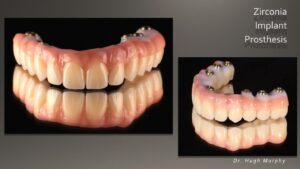
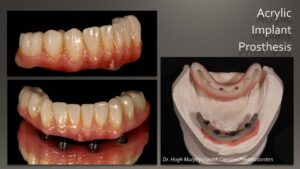
Inside a full-arch prosthesis: acrylic teeth over a titanium bar that attaches to the implants.
You don’t have to pick one material for both arches. Some patients choose zirconia on top, where the smile shows most, and acrylic over titanium on the bottom.
Why maintenance matters
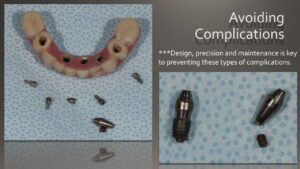
Without good design and regular maintenance, full-arch prostheses can wear through and screws can loosen or break.
Full-arch implants are built to last, but only with regular care. Plan on a maintenance visit about once a year.
At each visit, the teeth are unscrewed and removed, the implants and the underside of the teeth are cleaned, and everything is checked before it goes back in. “It’s like the service on your car,” Dr. Murphy says.
This matters because you can’t clean under a fixed bridge yourself. Skip maintenance for years and buildup collects underneath, which can lead to infection and bone loss around the implants. Parts can also wear: screws loosen or break, and the teeth wear down.
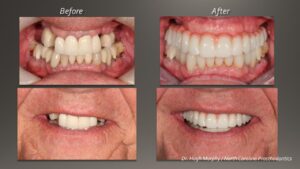
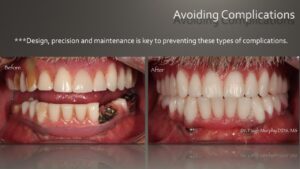
A worn, broken restoration rebuilt with new full-arch implant teeth.
Already have implants that are failing? Premier regularly repairs implant work done elsewhere: broken screws, broken or loose implant teeth, failed implants, and implant teeth that simply don’t look right. As Dr. Murphy puts it: “Not many other people are good at managing those situations.”
How much do full-arch implants cost?
Every full-arch case is different, so the cost depends on your bone, whether you need extractions or grafting, and the material you choose for your teeth. One thing that doesn’t change the price at Premier: the number of implants. You won’t be charged more because your case needs five or six instead of four.
The bigger cost to think about is getting it wrong. As Dr. Murphy says, “What you really can’t afford is having to do it over.” At your consultation, you’ll get a clear plan and price before you decide anything.
Why choose Premier Prosthodontics for full-arch implants in Raleigh?
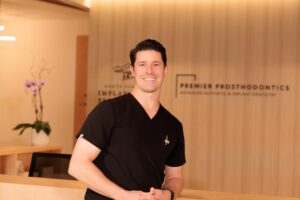
A board-certified prosthodontist designs your teeth. Dr. Hugh Murphy, DDS, MS, FACP, is a specialist in replacing teeth and restoring bites.
A periodontist places the implants. Dr. Thiago Morelli works in the same office, so surgery and teeth are planned together.
An in-house lab. Your teeth are designed and adjusted on site, not at the mercy of an outside lab.
We fix what didn’t work elsewhere. From broken screws to failed implants, complex repairs are a specialty.
Book a full-arch implant consultation
Your first visit includes a CT scan, reviewed with you right away, and you’ll leave with a treatment plan. Bring past dental records if you have them, though you don’t need to bring anything.
Dr. Hugh Murphy is a leading prosthodontist serving patients in Raleigh, Durham, Chapel Hill, and surrounding North Carolina communities. Recognized as the area’s best Prosthodontist and Cosmetic Dentist by Raleigh’s Best Awards in 2025 and 2026, he is a Board-Certified Prosthodontist and Diplomate of the American Board of Prosthodontics. He earned his dental degree from the University of Southern California before completing his specialized prosthodontic training and Master’s degree at UNC-Chapel Hill, where he serves as an adjunct clinical professor. Combining his extensive dental training with his background as a professional artist and published author, Dr. Murphy handcrafts bespoke restorations in his in-house dental lab to create beautiful, highly functional smiles. He specializes in complex cosmetic and restorative treatments, including implant-supported dentures.